
Stop the Scroll: Ad-Ready Trailers
Hi, I'm Louis. This guide is about how to make a trailer video that is good enough to run as an ad: what makes one work, how we judge them, and what we are looking for.
Why make your trailer ad-ready?
If your trailer is good enough for ads, three things happen:
- Your content gets featured. We put it front and center on the platform, so it is the first thing every new user sees when they arrive.
- Your referral code goes on the ad link. Every user who registers because of your video becomes your referral. You earn a 5% profit share from each of those users for 6 months.
- You get a first top-up bonus. You earn 50 ARCANE the first time each of those users tops up.
Put together, this is real passive income, and it can bring in enough ARCANE that you never have to buy any again.
We also run trailer contests with cash prizes for the winners. A prize pool looks like this:
| Place | Prize |
|---|---|
| 🥇 1st Place | $1,000 USD |
| 🥈 2nd Place | $500 USD |
| 🥉 3rd Place | $200 USD |
| 🏅 4th and 5th Place | $100 USD each |
Contests are seasonal, so the prizes, dates and details change. Always check our Discord for the current one.
You don't have to take my word for it. Look at last month's referral leaderboard. The creators at the top are the ones whose videos performed well as ads.
If you are going to make a trailer anyway, you might as well make it a great one.
You have 3 seconds
Every good video comes down to storytelling, and in ads the storytelling has to start immediately.
Ads are a brutal place to compete. Your video is up against thousands of others, and most people skip an ad without even thinking about it. If you don't catch their attention in the first 3 seconds, they are gone for good.
There is more than one way to win those 3 seconds. Below are videos that did it, each in a different way, and why each one works.
Videos that work, and why
The Fox and the March, by Generic
The hook: drama.
The easiest way to win the first 3 seconds is to open with something dramatic, and this video does exactly that. Watch only the first 3 seconds and notice how much is already there: there is drama, there is a fight, and the characters are talking, so you know a story is unfolding.
Within those 3 seconds I am already captivated by the fox girl and how she looks, and I want to know what happens next. That feeling of "I need to see more" is exactly what your opening has to create.
The Succubus Wars, by Sussilus
The hook: pure aura.
This work by Sussilus is truly unique. It redefines what AI creativity can be.
It doesn't open with drama or dialogue at all. Instead, the first 3 seconds are maximum aura: the music, the visuals, and the transitions are so captivating that the video is hard to ignore.
It also has the element of surprise. Nobody has seen anything quite like it, so people keep watching just to see what comes next.
That is another way to catch attention: be unlike anything else in the feed.
THE ROOMBA OF DOOM, by ISEKAI ZERO
The hook: comedy and absurdity.
This is our best performing ad of all time, and the main reason is simple: it is funny and captivating from the very first moment.
It starts with a dramatic scream, and then a portal opens. That is very hard to ignore. In a way it forces you to keep watching.
The story is the classic "fish out of water" trope. Someone from a fantasy world lands in the real world and ends up fighting a Roomba, something almost everyone recognizes. The absurdity, and not knowing where it is going, is what makes it so unique and captivating.
It is entertaining enough that random people have reposted it on Instagram Reels on their own. When strangers share your ad for free, you know it works.
Another World Under Twin Moons, by Chestnut
The hook: a grand story is about to begin.
This is a great example of great storytelling. It is not fast paced and it is not comedic, but it works because of the opening. From the start, the whole video feels like someone is about to tell you a grand fantasy story.
The plot is pretty simple, and that is fine. You don't always need something complicated.
What it does really well is make me feel like I am the Descender. I am immediately curious about what I would do in that position, and I am ready to go and do something in this world. A trailer that makes the viewer picture themselves inside the story has already done most of the selling.
Sovereign Skies, by KnightArtorias
The hook: a theme people already love.
This is a really great trailer, and you can feel the love for the source material: fighter jets and dogfights. It resonated with a lot of viewers who are fans of the same things, and it is made in a way that truly feels like a movie trailer.
At first sight everyone thinks of Ace Combat, yes. But it also opens up a question most people have never asked themselves: what if I were one of those fighter pilots? What would I do?
Here the hook is the theme itself. People who love this kind of thing will stop for it every time, so if you know your audience and treat what they love with care, the theme does the work for you.
Beyond the hook: what else makes these videos great
The hook and the appeal get people to stop scrolling. What makes them stay is everything after it: the story, the flow, the vibe, and the energy. But when you look at the videos above, they also have four other things in common.
Style: it looks like real anime
This is one of the most important factors. None of these videos gave me the impression of "AI style" at first sight. They stay true to how a real anime looks, so people can't tell they were made with AI.
That matters because AI-made content carries baggage. Everyone has seen too much AI slop online and they are really tired of it. The moment they sense even a tiny bit of "AI made", they swipe away so they don't waste their time.
The most common giveaway is a style that is too heavily saturated, especially the default oil painting look you get from GPT Image 2:
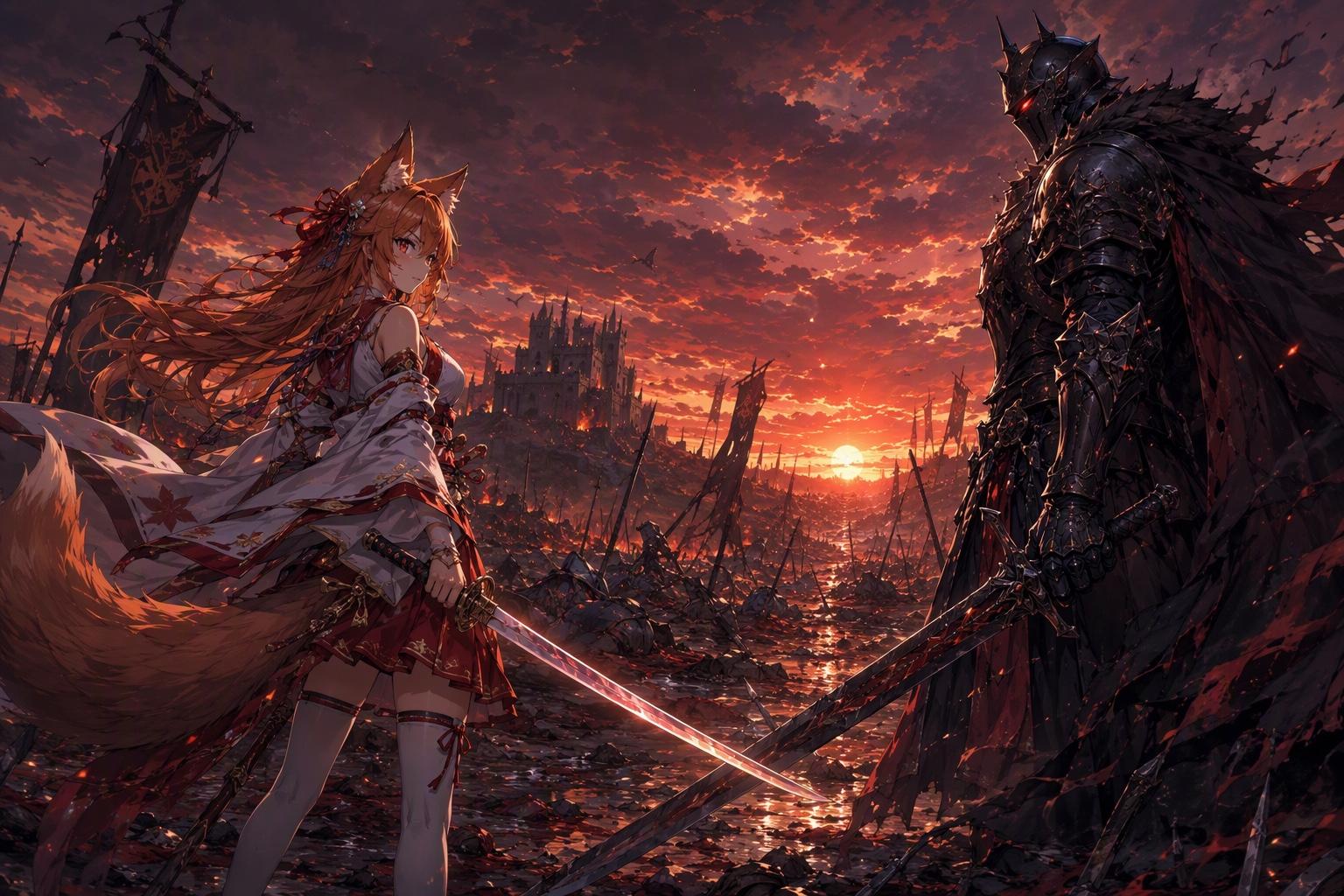
GPT Image 2 with a plain prompt and no style direction. Heavily saturated, painterly, and instantly recognizable as AI.
Trailers with the GPT image oil painting look are now automatically disqualified.
The golden standard: your video should look like an actual anime. If someone could mistake it for a clip from a real show, you are on the right track.
Movement: it moves like real anime
The second thing is action and movement. Ask yourself: does it feel natural? Does it feel like a real anime?
Some people like to use the first frame and last frame feature for video generation. The result often looks like a slideshow. The movement feels unnatural and weird, and you can clearly tell that each shot started as a still image.
Here is what that looks like, using the image above as the first frame:
Seedance 2.5 animating between two GPT Image 2 stills with first frame and last frame. It moves for about two seconds, then settles onto the final still and just holds the pose.
Immersion: nothing pulls you out
The third thing is immersion. Go through your video scene by scene and ask: does anything here break the immersion, even for a moment?
If something uncanny or unnatural happens at any point in your video, people snap out of it. One bad moment is enough.
Most of the time the cause is consistency. Something does not stay the same from one shot to the next, and the viewer notices.
Here is one of our own test clips. The art style is fine and the animation is lively, but watch what happens between the cuts:
- People change seats. The blonde girl walks up on the right side of the pink-haired girl. In the next shot (around 0:10) she is sitting on her left.
- They swap again. At 0:13 the blonde girl is on the left and the red-haired girl is on the right. In the close-up at 0:17 they have switched sides, and in the wide shot at 0:22 they are back.
- The drinks keep changing. The scene starts with two bottles on one tray. A few seconds later there are three, and they sit in a different spot on the table in almost every shot.
- The dialogue does not match the picture. She says "That was my last one" about her fries, while holding a fry, with a full tray of fries still on the table.
None of these is a big mistake on its own. But every one of them makes the viewer stop and think "wait, what?", and that is the moment the immersion breaks.
This happened because the prompt never said where each person sits or what is on the table, so the model made it up again in every cut.
Pacing: nobody has a long attention span anymore
The fourth thing is pacing. People today don't have the patience to sit through a slow video, and in an ad feed they have even less.
Look at Cocomelon. It is made for toddlers, and it changes scene every 2 to 5 seconds. That is not an accident. It is the pace that keeps a child's eyes on the screen.
Adults are not that different anymore. We just don't like to admit it.
You don't have to cut that fast. But when a scene stays static for too long, the video starts to feel stagnant and slow, and that is the moment people swipe away. If nothing new is happening on screen, a camera move, a reaction, a new angle, a cut, the viewer has no reason to keep watching.
Don't overdo it either. This is what too much looks like:
A zoom, a sting and a new angle every half second, over and over. It is funny for a few seconds and exhausting after that. When everything is dramatic, nothing is.
There is no magic number. A quiet emotional moment can hold longer than a fight scene, and a fight scene should never sit still. Watch your own trailer and be honest about where your attention drifts. Then find your own artistic balance that feels right.
Tools and workflow
The tools
You don't need much:
- Editing: the free version of CapCut is mostly all you need.
- Image model: for your reference images, we recommend GPT Image 2.5 and Seedream 5 Pro.
- Video model: Seedance 2.0 and Seedance 2.5 are the ones we recommend most.
- Resolution: 480p is sufficient for ads. 720p and above is preferred, but it is expensive.
- Music: we recommend Suno to generate your music. Never use copyrighted music.
Never use first frame and last frame
First things first: you should never, ever use the first frame and last frame feature for video generation. You saw the result above.
Use reference images instead. Give the model images of your characters as references and let it create the motion itself, instead of forcing it to travel from one still picture to another.
Your reference images decide the style
Seedance depends heavily on the style of your reference images. Whatever style your references are drawn in is the style your video comes out in.
In our tests, changing the style words in the prompt barely changed the look. Changing the reference images changed everything.
Here is an example. We made these references in a 90s cel anime style: two character sheets, a style frame, and a background.


And this is the video Seedance 2.5 made from them:
It looks like a 90s anime because the references look like a 90s anime. Compare it with the clips in the next section: same video model, same kind of prompt, a completely different look.
By the way, these references were made with GPT Image 2, the same model as the oil painting example earlier. The model is not the problem. The default look is.
The references can come from almost any image model. We gave the same character sheet prompt to eight different image models, and every one of them could draw the flat cel look we asked for:

So it is flexible. Look for the style you want, make your reference images in that style, and the video will follow. Best of all, find your own unique style.
References are not only images
Seedance can take more than images as references:
- A previous video. Give Seedance a clip you already made and ask it to continue from there. The new clip picks up where the last one ended, so you can build one continuous scene across several generations.
- Audio. Give it a voice clip as a reference, and the character keeps the same voice from one clip to the next.
- Music. Give it a song as a reference and you can ask your character to sing it, or have the action sync with the music.
One thing to know: on the API we use, the video you reference is billed as well. Use it to keep a scene continuous, not to save money.
Use AI to solve the AI problem
If you write the video prompt by hand, the movement can never look natural, and neither can the dialogue. So we don't write it by hand. We let an AI write it.
Our usual workflow:
- Upload all your character images to Claude. We use Claude with a subscription as our prompter.
- Describe exactly what you want. Tell it the shot, how it looks, how it feels, and anything else that matters to you.
- Ask it for a Seedance 2.5 prompt. It will write the prompt for that exact shot.
- Generate the video in Seedance with that prompt and your character images as reference images.
- Edit the clips together in CapCut.
You can use any AI for this. GPT, for example, also does it well.
There is no shortcut
There is no shortcut to a good video. Even with a good prompt, not every generation comes out the way you wanted.
The only way is to play the gacha game: generate, look at the result, reprompt, and generate again, until hopefully you have every shot you wanted. Then you just cut them together.
Use draft mode if you want high quality
Seedance 2.5 has a draft mode. You generate a 480p version first, and once you are happy with it, you render that same clip at 1080p.
If you are aiming for high quality, this ends up saving you more, because you only pay the 1080p price for the shots you actually keep.
If you are aiming for 480p anyway, skip draft mode and just generate directly.
Sign your work
At the end of your trailer, you can add your own signature for about 3 seconds, such as your intro or your name. It is optional, but we recommend it.
What this workflow can do
Here are four clips we made this way, using storylines from our platform: The Fracture and Praxis Astra by Generic, and Neither Hero nor Villain by Sussilus. Each one is a single 30 second generation from Seedance 2.5 at 720p, straight out of the model with no editing. Claude wrote every prompt from the character images and a description of the scene we wanted.
Each card shows the result, the reference images we gave the model, and the full prompt.
Action: the forest fight
From The Fracture. Ellen and Jett run into something in the Hollow.
Reference images
Two characters, their powers, and the location.


Show the prompt
Non-stop fight: the boardwalk
From Praxis Astra. Shirumi and Felicia trade blows along the waterfront.
Reference images
Two characters, their fighting faces, and the location.


Show the prompt
Quiet tension: the Still Shard
From The Fracture. Vespa walks into Sasha somewhere she should not be.
Reference images
Two characters, one power, and the location.


Show the prompt
Emotion: the dorm room
From Neither Hero nor Villain. Aoi finds Maiya crying alone on a rainy night.
Reference images
Two characters and the location.


Show the prompt
Requirements and rules
These are the usual requirements for a trailer. Each contest season can be different, so always check our Discord for the current details.
The specs
- Length: minimum 1 minute, maximum 3 minutes.
- Quality: minimum 480p.
- Format: 16:9 or 9:16.
- Pacing: it must be entertaining and fast paced.
- Source: it must be based on a storyline on our platform.
- Style: anime style is preferred. The GPT image oil painting look is automatically disqualified.
- No realistic humans. Realistic-looking people are not allowed, in the contest and on the platform itself.
- Submissions: there is no limit on how many you submit, but you can only win one prize.
Rules to keep in mind
- No copyrighted music. Ads with copyrighted audio can get taken down on ad platforms. We recommend using Suno to generate your music.
- Using a storyline that isn't yours? You must get permission from the original author first.
- Keep it SFW looking. Suggestive is fine, but too sexy is not allowed. This is about how the video looks. Your storyline's actual content rating doesn't matter.
- No realistic humans. This is a platform rule, not only a contest rule. Realistic-looking people are not allowed anywhere on ISEKAI ZERO, so they are not allowed in your trailer either.
- The storyline must stay public. If your video is selected to run as an ad, the storyline cannot be made private.
- Revisions may be requested when needed before your ad goes live.
How we judge
When we decide which trailers to run as ads, these are the questions we ask, roughly in this order:
- Does it hook me in the first 3 seconds? If I saw this in my feed, would I stop scrolling? It can be drama, aura, comedy, a grand opening, or a theme people already love. It only needs one, but it needs it right away.
- Does it look like real anime? At first sight, can I tell it was made with AI? Heavy saturation is an instant giveaway, and the GPT image oil painting look is an automatic disqualification. Realistic humans are not allowed at all.
- Does it move like real anime? Do the actions feel natural, or does it look like a slideshow of still images that started moving?
- Does anything break the immersion? Is there any moment that feels uncanny or unnatural, or where something is not consistent from shot to shot?
- Does the story carry me to the end? Flow, vibe, and energy. Each scene should make me want to see the next one.
- Does it keep moving? Does any scene sit still long enough that I would have swiped away?
- Does it make me want to play? When it ends, am I curious about what I would do in this world?
- Is it its own thing? Have I seen something like this before, or does it surprise me?
- Can we actually run it as an ad? It has to follow the rules above: SFW looking, and no copyrighted music.
A trailer doesn't have to be perfect on every point. But the first two come first for a reason: if the hook fails or the video looks AI-made, people are gone before the rest of it gets a chance.
Wrapping up
If you only remember a few things from this guide, make it these:
- Win the first 3 seconds. Drama, aura, comedy, a grand opening, or a theme people already love. Pick one and open with it.
- Make it look and move like real anime. No AI look, and no slideshow movement.
- Protect the immersion. One inconsistent moment is enough to lose the viewer.
- Keep it moving. Don't let a scene go stale, but don't cut like a fever dream either.
- Use reference images, and let an AI write your prompts. Never use first frame and last frame.
- Be ready to re-roll. There is no shortcut. Good trailers come from generating, reprompting, and cutting the best shots together.
A trailer that does all of this is more than a contest entry. It can be featured on the platform and run as an ad with your referral attached, so it keeps earning for you long after you finished it.
So find your own style, make something only you would make, and check our Discord for the current contest. I am looking forward to seeing what you create.
Credits
Thank you to the creators whose work appears in this guide.
Trailers
- The Fox and the March, by Generic
- The Succubus Wars, by Sussilus
- Another World Under Twin Moons, by Chestnut
- Sovereign Skies, by KnightArtorias
- THE ROOMBA OF DOOM, by ISEKAI ZERO
Storylines and characters used in our test clips
- The Fracture, by Generic: the forest fight and the Still Shard clips.
- Praxis Astra, by Generic: the boardwalk fight clip.
- Neither Hero nor Villain, by Sussilus: the dorm room clip, and the characters in the cafeteria clip.